
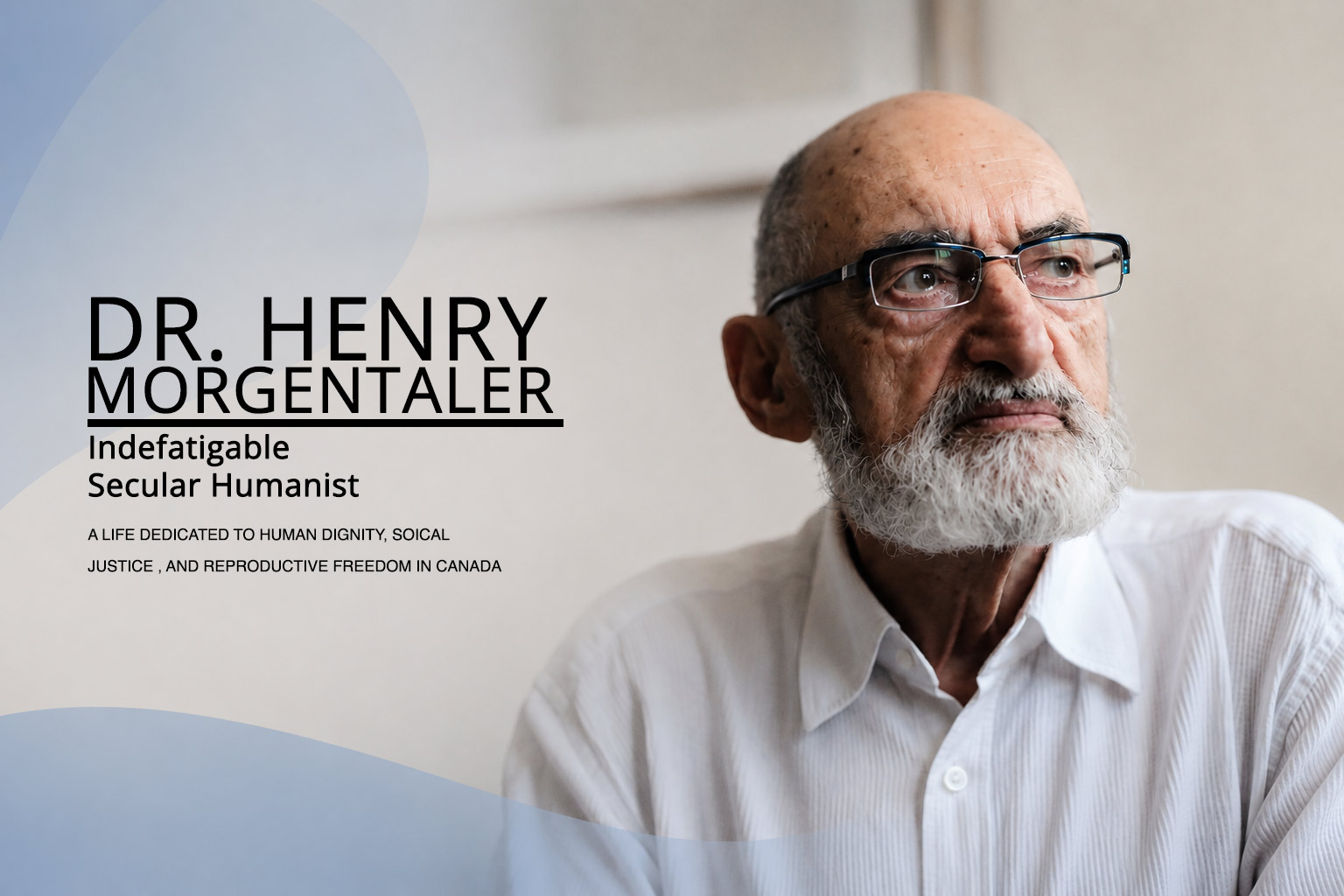
Dr. Henry Morgentaler: Indefatigable Secular Humanist
By Richard Thain
Dr. Henry Morgentaler had known antisemitism throughout his life. He experienced it in pre-Second World War Poland, endured the Holocaust, encountered religious discrimination while studying medicine in post-war Germany and Belgium, and was refused admission to McGill University because of its quota limiting Jewish students.
Morgentaler graduated from the University of Montreal Faculty of Medicine in 1953, earning the gold medal. As a medical resident at Montreal’s Royal Victoria Hospital, he witnessed a ward filled with women suffering the devastating consequences of unsafe, illegal abortions. Some did not survive. These experiences reinforced his belief that people are fundamentally good, but that corrupt institutions can enable great evil.
Having survived the Auschwitz and Dachau concentration camps, Morgentaler weighed only 70 pounds when he was liberated at the age of 22. He emerged from the war determined to lead a meaningful life by combating injustice and helping to build a better society.
In 1963, Dr. Morgentaler found his philosophical home when he attended a lecture sponsored by the Humanist Fellowship of Montreal. The speaker, representing the Ethical Culture Society of New York, introduced him to secular humanism—a philosophy and worldview previously unknown to him. Its emphasis on improving society through reason, scientific inquiry, and human compassion deeply resonated with him.
Humanism makes no appeal to the supernatural. It holds that human problems must be solved by human beings. Humanists strive to build a more just and compassionate world by promoting fairness, equality, social justice, and universal human rights. Inspired by these ideals, Henry Morgentaler joined the Humanist Fellowship of Montreal that very evening.
Soon after joining the Humanist Fellowship of Montreal (HFM), Henry Morgentaler was elected to its board of directors. A vacancy had arisen when Pierre Elliott Trudeau stepped down from the board after becoming Canada’s Minister of Justice. In 1964, Dr. Morgentaler was elected president of the HFM.
As president, he founded the HFM’s Committee for Neutral Schools. He delivered public lectures and wrote opinion pieces advocating an end to Quebec’s religion-based public school system. As he explained:
“This is a democratic country, and if people aren’t Catholic or Protestant, they shouldn’t have a religion that is not theirs imposed upon them. It separates people according to creed, and we want people to live together in peace.”
Henry Morgentaler was, in many respects, ahead of his time. Although the HFM’s campaign for neutral schools was unsuccessful, history ultimately moved in the direction it had advocated. Three decades later, Quebec modernized its publicly funded education system by replacing religion-based school boards with language-based school boards. Many advocates believe similar reforms remain overdue in provinces such as Ontario, Saskatchewan, and Alberta.
On October 17, 1967, Dr. Morgentaler travelled to Ottawa to present the Humanist Fellowship of Montreal’s brief to the House of Commons Standing Committee on Abortion Law Reform. He argued that the decision whether to continue or terminate a pregnancy should rest with the woman, in consultation with her physician. His proposal was reported the following day in newspapers in Montreal and Toronto. At the time, the idea of abortion on request during the first trimester was considered revolutionary. Morgentaler believed that such a policy could eliminate the dangerous and often fatal consequences of illegal back-alley abortions.
The publicity generated an immediate response. His telephone rang throughout the day as women pleaded for abortions for themselves, their daughters, or their nieces. Some arrived at his medical office seeking help. Having argued in Ottawa that abortion should be removed from the Criminal Code, he now faced a profound moral dilemma. He did not want to violate the law, yet he found it impossible to turn away desperate women whom he believed would otherwise resort to unsafe, illegal abortion quacks.
In 1968, several regional humanist organizations united to establish the Humanist Association of Canada, and Henry Morgentaler became its first president. On January 9, 1969, Dr. Morgentaler performed his first abortion for the 18-year-old daughter of a Unitarian friend, who was a nursing student.
He had crossed the line from advocating legal reform to openly defying the law. Believing that reform was proceeding far too slowly while women continued to be injured or die from unsafe abortions, he deliberately chose civil disobedience. His intention was to be charged, stand trial, and explain to a jury of his peers that Canada’s abortion law was cruel, unjust, and harmful. He believed that ordinary Canadians would understand. He was right. Dr. Morgentaler was prosecuted three times in Quebec, and on each occasion a jury acquitted him, despite the province’s predominantly Roman Catholic population.
Over the following decades, thousands of women from every walk of life sought his care because they had decided not to continue their pregnancies. Morgentaler often recalled the relief many expressed after the procedure, when he could tell them, “I am happy to tell you, you are no longer pregnant.”
Dr. Morgentaler eventually established eight abortion clinics across Canada. He trained dozens of physicians in the suction curettage technique that he helped introduce into Canadian medical practice and personally performed more than 60,000 abortions without a patient death. In 2001, the American Journal of Medical Quality reported that the quality of care in his clinics exceeded that of abortions performed in Ontario hospitals, with lower rates of complications such as infection and hemorrhage.
Throughout his career, Dr. Morgentaler faced intense and often bitter opposition. He endured repeated criminal prosecutions, civil lawsuits, death threats, financial hardship, and imprisonment. While incarcerated, he suffered a heart attack. At his Toronto home, where he lived with his wife and son, the family kept the curtains closed because other Canadian abortion providers had been targeted by sniper attacks.
On May 18, 1992, his Toronto clinic was destroyed by a firebomb. Less than five hours after the explosion, the Reverend Ken Campbell, president of Choose Life Canada, issued a news release asking whether the bombing might have been “an act of God.”
In recognition of his contributions to women’s health care and his decades of public service, Dr. Morgentaler was appointed a Member of the Order of Canada (C.M.), and the investiture was conducted by Governor General Michaélle Jean on Canada Day, July 1, 2008.
Richard G L Thain BSc DDS
Reference:
Morgentaler: A Difficult Hero. A biography by Catherine Dunphy
Toronto: John Wiley & Sons Canada, Ltd. (2003) ISBN 0-470-83356-4.
The Morgentaler Amendment
A jury found Dr Morgentaler, not guilty. A judge overturned the jury verdict and proclaimed him guilty! … Say whaaaaaat?! Really?
Here’s the background:
In 1973, Henry Morgentaler was acquitted by a jury in Quebec of performing an illegal abortion. The Quebec Court of Appeal overturned the jury’s acquittal and substituted a conviction without ordering a new trial. In 1975, the Supreme Court of Canada upheld the Court of Appeal’s authority to do so under the Criminal Code as it then existed. The decision caused widespread public and legal criticism. Many believed that allowing an appeal court to replace a jury’s not-guilty verdict with a guilty verdict undermined the role of the jury.
In response, Parliament passed an amendment to the Criminal Code in 1975, commonly known as the Morgentaler amendment. It changed the law so that:
An appeal court can no longer substitute a guilty verdict for a jury’s acquittal.
If the Crown successfully appeals a jury acquittal because of a legal error, the remedy is a new trial, not a conviction entered by the appeal court.
This rule remains in effect today. A jury’s not-guilty verdict cannot simply be replaced with a guilty verdict by an appellate court. If reversible legal error occurred during the trial, the accused may be tried again before a new jury, but the appeal court cannot itself convict the accused.
The Morgentaler amendment is widely regarded as an important protection of the constitutional role of the jury in Canada’s criminal justice system.