
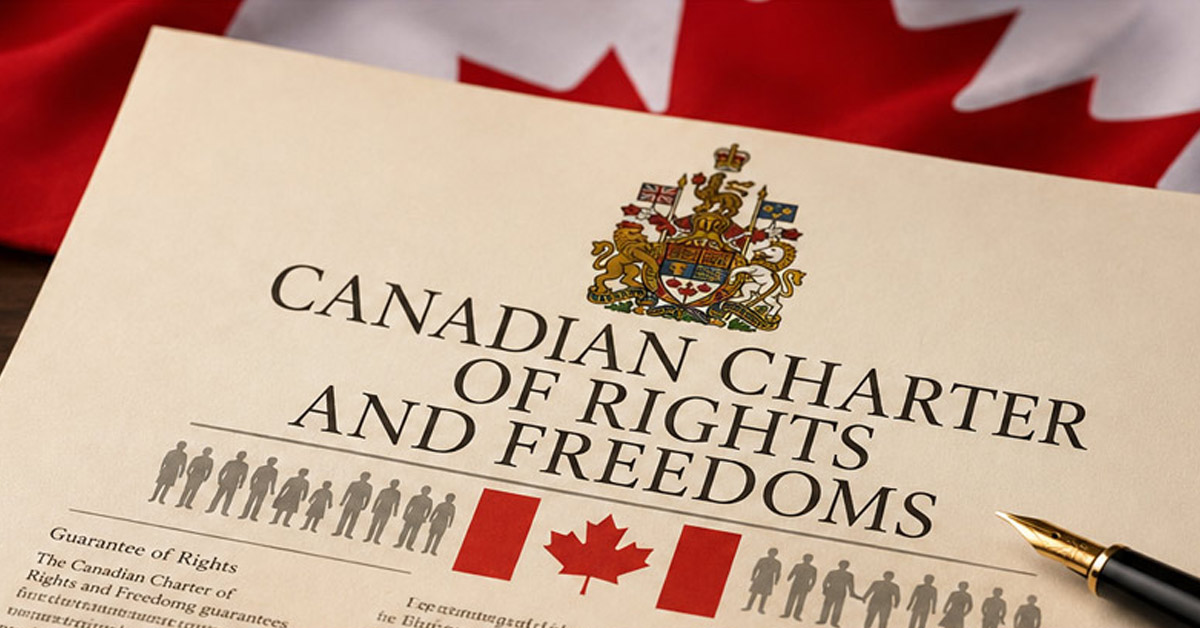
Background Information on the Petition to Remove the Reference to ‘God’ from the Preamble of the Canadian Charter of Rights and Freedoms
TO THE HOUSE OF COMMONS
We, the undersigned citizens (or residents) of Canada, draw the attention of the House to the following:
THAT the section of the Preamble to Canada's Charter of Rights and Freedoms (Constitution Act, 1982) that reads: Whereas Canada is founded upon principles that recognize the supremacy of God... is a discriminatory reference and offensive to millions of Canadians who are non-Christian or non-religious.
THAT each incident that discriminates against non-Christian or non-religious Canadians due to government-endorsed religious reference or exercise, harms the public in general, in that such preferential endorsement by the government belies the whole intent and purpose of the Charter of Rights and Freedoms.
THAT this basis for discrimination against all non-Christian and non-religious Canadians would be greatly alleviated if the following legislative measures were taken.
THEREFORE, your petitioners call upon Parliament to enact legislation to change the Preamble to Canada's Charter of Rights and Freedoms from:
"Whereas Canada is founded upon principles that recognize the supremacy of God and the rule of law" to read:
Whereas Canada is founded upon principles that recognize the supremacy of intellectual freedom and the rule of law,
AND that Section 2(a) of the Fundamental Freedoms be changed from:
"freedom of conscience and religion" to read:
freedom of conscience, and both freedom of and freedom from religion.
HOUSE OF COMMONS DEBATES
PRESENTATION OF PETITION
June 10, 1999
THE CONSTITUTION
Mr. Svend J. Robinson (Burnaby-Douglas, NDP):
Mr. Speaker, I am presenting two petitions this morning.The first petition has been signed by residents of my constituency of Burnaby-Douglas as well as communities across Canada.
The petitioners, members of the Humanist Association of Canada and others, seek changes to the preamble to Canada's constitution and to the charter of rights. They wish to remove the reference to the supremacy of God in the preamble and to change the wording of the charter of rights to reflect the fact that Canada is a secular country which respects the deeply held views of people of many different religious faiths as well as those who have no religious beliefs.
SVEND J ROBINSON, MP
BURNABY-DOUGLAS
366 WEST BLOCK, HOUSE OF COMMONS, OTTAWA, K1A OA6
613-996-5597 ROBINS@PARL.GC.CA
PETITION NO. 361-2552
BY Mr. Robinson
DATE: June 8, 1999
Received by HAC November 02, 1999
RESPONSE BY THE MINISTER OF JUSTICE AND ATTORNEY GENERAL OF CANADA
SUBJECT
Canadian Charter of Right and Freedoms
RESPONSE
The Canadian Charter of Rights and Freedoms provides protections for all Canadians, whatever their background or beliefs. Key Charter provisions ensure that this is so. Sub-section 2(a) of the Charter expressly protects freedom of conscience and religion as one of the fundamental freedoms, which includes non-religious and minority religious beliefs. Section 15 of the Charter guarantees every individual the right to equality. Section 27 provides for the interpretation of the Charter in a manner that is consistent with the multicultural heritage of Canadians. The preamble of the Charter must be read in this context. Infact, the courts have made it clear that the preamble must be read consistently with freedom of conscience,and cannot take away from this freedom, Thus, freedom of conscience including the freedom to hold nonreligious beliefs is protected by the Constitution.
Canadians hold a wide variety of beliefs, and the courts have made it clear that accommodating these beliefs is an important principle guiding the interpretation of the Charter. In this context, there are no plans to bring amendments to the preamble of the Charter.
The cartoons approached the constitutional debate from several satirical angles. One translated the question of religious language into the absurdity of corporate bureaucracy, while others used Christian imagery and political caricature to comment on Svend Robinson’s campaign to remove God from the Constitution. Together, they capture the humour and symbolism surrounding a broader secularist argument: that Canada’s constitutional framework should not privilege religious belief.
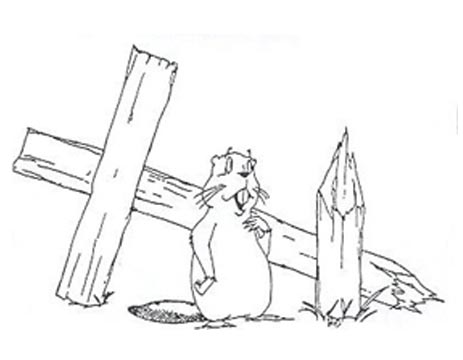
The Canadian beaver is transformed from a passive symbol of crucifixion into the agent of destruction. Having chewed through the base of a wooden cross, the beaver stands beside the fallen structure, turning a familiar Canadian symbol into a pointed visual metaphor. The cartoon plays on the tension between Canada’s Christian heritage and the movement to remove religious references from the country’s constitutional framework.
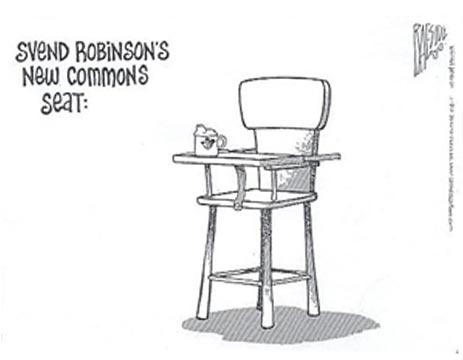
Adrian Raeside’s minimalist cartoon turns the political consequences of Robinson’s position into a joke about infantilization. The empty Commons seat is replaced by a child’s wooden high chair, making Robinson’s campaign to remove the reference to God from the Constitution the subject of a deliberately dismissive political joke. The cartoon reflects the resistance Robinson’s initiative encountered and illustrates how opponents of the petition used caricature to portray the secularist position as politically out of place.
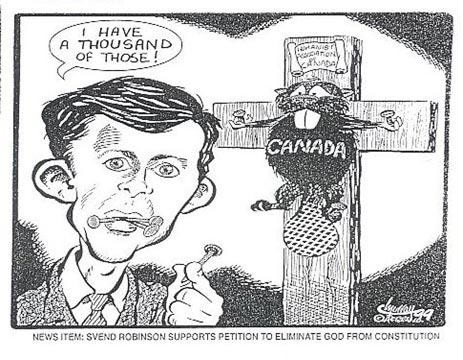
Malcolm Mayes’ striking 1999 caricature uses traditional Christian imagery to portray the campaign to remove the reference to God from the Constitution as an attack on Canadian identity. The Canadian beaver, a longstanding national symbol, is shown crucified on a cross bearing the name of the Humanist Association, with the petition’s signatures represented as the nails. Through deliberately provocative imagery, Mayes casts secularism as a threat to Canada’s Christian heritage, conflating the removal of religious language from the Constitution with an attack on Canadian identity itself.
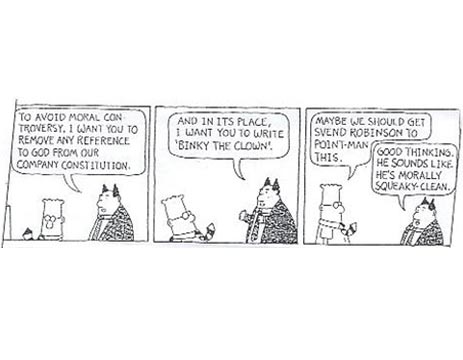
In this syndicated Dilbert strip, the push for secular inclusion is equated with corporate risk-averseness. By suggesting that "God" be replaced with a meaningless character like "Binky the Clown" to avoid moral controversy, the cartoon mocks the concept of absolute neutrality. It implies that removing traditional moral anchors from foundational texts leaves behind an ideological vacuum occupied only by the trivial. Furthermore, the boss's ironic description of Svend Robinson as "morally squeaky-clean" directly references the political elite’s view of Robinson as an anti-establishment provocateur whose motives were inherently suspect.
HUMANIST ASSN. OTTAWA
"STATE - CHURCH KEEP THEM SEPARATE"
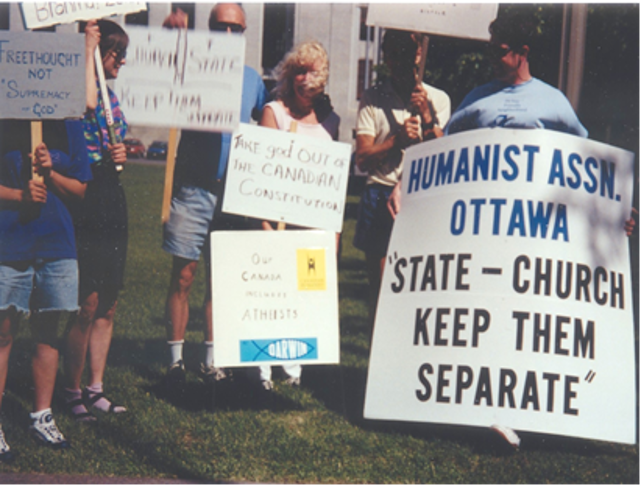
The photo captures an outdoor rally in Ottawa. A group of, dedicated secular demonstrators stands together, holding hand-painted signs and placards advocating for the separation of church and state.
The demonstrators are dressed in casual, late-1990s summer attire, shorts, t-shirts, sneakers, and sunglasses. This reflecting a community-driven demonstration. The bright sunlight and historical signage provide an authentic visual record of Humanist Ottawa’s direct public mobilization during the peak of the preamble controversy.